Featured Post

Bit and Luke’s Stylish New Mexico Wedding by Jackie Marko Photography
Today I take you to New Mexico for the gorgeous wedding of Bit and Luke who...


Today I take you to New Mexico for the gorgeous wedding of Bit and Luke who...
1
Oct
2026

By Boho
The wedding band is often the last ring you choose. It can also be the one that makes the pair.
A narrow gold curve can bring a floral engagement ring into focus. An engraved band can lend a little romance to a plain solitaire. Put two favourites together, though, and something may feel off. The outline you loved disappears, or all you notice is a broad stripe of sparkle.
Your engagement ring and wedding band make up your bridal set. Worn together, they create a two-ring stack. You can combine botanical details with textured gold, or keep one ring plain. The pieces can share a colour or a small design detail without matching at every turn.

Start with the detail you would miss if it disappeared. On a floral engagement ring, that might be the small stones forming petals around the centre. On a plainer ring, it could be the rounded gold band you enjoy almost as much as the diamond.
A simple wedding band is a useful starting point, even if you’re convinced you want plenty of decoration. It lets you see the engagement ring’s outline before adding another pattern to the picture. If you already have your engagement ring, bring it to the appointment so you can try the two together.
If you’re choosing both pieces from scratch, make room for the wedding band while browsing engagement rings. Lily Arkwright’s engagement rings with lab grown diamonds include solitaire, halo and vintage-inspired settings. Compare a plain solitaire with a more decorative design, imagining the same wedding band beside each. An engraved band may be the detail that makes you favour the simpler engagement ring.
For a floral setting, a curved wedding band gives you a different outline to consider. One curve may follow the petals neatly; another may leave more space than you want or sit partly beneath the setting. Two bands that look much the same in their boxes can sit quite differently beside your ring. A different curve may be all the pairing needs.
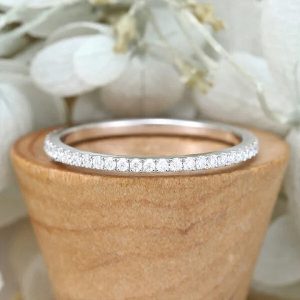
Adding diamonds to the wedding band changes the effect again. You may still see the flower clearly, or find that the two rings become one fuller cluster of sparkle. Which version makes you want to keep looking? A chevron band, with its V-shaped point, brings a sharper outline beneath the rounded setting.

“Yellow gold” tells you little about the character of a finished band. Picture a softly rounded surface beside a flatter one with crisp edges. The colour is similar; the impression is quite different.
A rounded wedding band can continue the softness of curving shoulders beside the centre stone. A flat-faced band gives that same pair a more defined edge. It is worth trying both before deciding that the rings need identical shapes to belong together.
Texture offers another way to connect them. A lightly hammered wedding band beside a polished solitaire gives you a contrast to enjoy even without extra stones. If you love engraving too, compare the finishes separately before combining them. You may prefer to see one pattern clearly.
Where the decoration sits matters as much as what it looks like. An intricate pattern down the side of a wedding band might be mostly hidden when the rings are together. Seeing the band on its own will help you decide whether that detail still matters to you.
And leave a little plain metal in the picture if the pair feels crowded. Beside a leaf motif or a finely engraved edge, an undecorated band gives your eye somewhere to rest.

You may want your engagement ring and wedding band to sit flush, with no obvious gap between them when viewed from above. That close fit makes one tidy arrangement. A little daylight between the rings can look lovely too, particularly when it reveals the lower edge of an unusual engagement setting.
The whole-hand view can settle this surprisingly quickly. A gap that dominates a close-up photograph may look quite different when your hand is resting on a table. Take a photograph from a little further away and see whether the space helps you enjoy both designs.
If you prefer a closer fit, the curve needs judging against your exact setting. A band that follows a round cluster may leave an unexpected pocket of space beside a pear-shaped stone. You might like that shape, or find yourself wishing it would disappear. This is a useful thing to discover while you can still try another band.
The fit needs checking beneath the surface, too. Ask the jeweller to show you where the rings touch and whether the combination is suitable for regular wear. A neat appearance from above can’t establish that on its own.

An inherited wedding band can give this decision a different starting point. Perhaps it has a narrow engraved border, or a width you wouldn’t have chosen in a shop. Put it beside your engagement ring before deciding whether the two need to match.
If you’re still choosing an engagement ring, a simple setting may give the inherited band’s engraving room to stand out. Matching the metal colour might be enough to connect them. If the two golds look different together, give yourself a moment to enjoy the contrast before dismissing it.
Bring the actual ring to the appointment. A photograph won’t show how the surfaces meet, and an older piece should have its condition assessed before you plan to wear another ring against it.
There may be a better place for it on your other hand. Keeping it in use can matter more than making it fit a particular stack.

After all that attention to the pairing, give the wedding band a few minutes on its own. You may want to wear it that way sometimes, and it deserves a proper look.
A deep curve leaves an open space where the engagement setting usually sits. You might love that little sweep of gold by itself, or prefer a shallower shape. With a chevron, try turning the point towards your wrist and then towards your fingertips, if the design and fit allow it.
Once both rings are back on, open and relax your hand. Notice their combined width and how they feel between your fingers. If you keep adjusting the pair to make it comfortable, mention it to the jeweller before deciding.
Before leaving, photograph your favourite pairing and a simpler or more decorative alternative on the same hand, from the same angle. Take one of each wedding band alone, too. Keep the design names and band widths with the pictures so you can find the exact versions again.
Look at those photographs after the appointment, alongside a picture of the engagement ring on its own. Does your favourite band bring out the detail you loved at the start? If a narrow strip of gold does that better than the diamond-set band you came for, keep it on the shortlist. If the extra sparkle makes you smile every time, give that pairing another try.

This site uses Akismet to reduce spam. Learn how your comment data is processed.



Comments