Featured Post

Nicole & Colin’s ‘Under the Oaks’ Relaxed Texas Fall Wedding by Photos by Mkay
I have a gorgeous rustic fall wedding for you today, full of the most stunning...


I have a gorgeous rustic fall wedding for you today, full of the most stunning...
2
Jul
2026

By Boho
Dressing for a wedding used to be fairly straightforward: dark suit, polished shoes, little room for interpretation. That’s shifted. Many weddings now happen in gardens, vineyards, courtyards, or converted barns, and the dress code often lands somewhere between sharp and easy. In that setting, the best outfits don’t feel stiff or overly engineered. They feel considered. A softly tailored jacket, well-cut trousers, and one of the right italian dress shirts can cover a surprising amount of ground, from a daytime ceremony in the sun to an evening reception that runs late. The goal isn’t to look as though a stylist spent all morning on the outfit. It’s simpler than that: polished, comfortable, and right for the occasion.

“Relaxed” can be a misleading word. It sounds casual, maybe even careless, but wedding dressing still needs a bit of structure or the whole thing falls flat. What matters is softer tailoring rather than rigid tailoring: jackets with lighter canvassing, less shoulder padding, cleaner drape through the body, trousers that skim instead of cling. Nothing sloppy. Nothing tight enough to feel exhausting by the first drink.
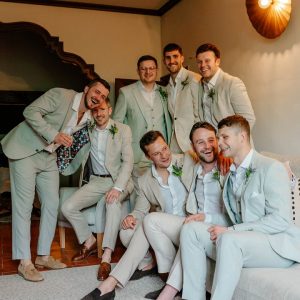
That softer approach makes particular sense at weddings built around a natural setting and an unforced atmosphere, as seen in a Devon celebration with warm earthy styling. A hard-edged business suit can feel slightly out of tune in those spaces. Too corporate. Too closed-up. A relaxed blazer with pleated or tapered trousers tends to sit better with the mood while still looking fully dressed.
And then there’s the shirt. Even without a tie, even with an unstructured jacket, a crisp collar gives the outfit direction. Small thing, big difference.

A good outfit can be ruined by the wrong cloth. That’s especially true at weddings, where men are expected to sit, stand, move, greet people, eat, maybe dance, and do all of it over several hours, often outdoors. If the fabric traps heat or creases in all the wrong places, it shows.
Linen remains the obvious summer favourite because it breathes beautifully and never looks too try-hard. Yes, it wrinkles. That’s part of the appeal. But it isn’t the only option. Lightweight cotton, linen-cotton blends, seersucker, fresco, and tropical wool all do the job well when the dress code calls for ease without looking underdressed.
That matters more now than it once did. The CDC’s heat guidance continues to emphasise light clothing and practical planning during hot weather, and wedding guests ignore that at their own risk. A heavily lined suit might look fine when leaving the house. Three hours later, in direct sun, it’s another story.
Half-lined jackets, open-weave wool, and breathable shirting usually land in the sweet spot. Smart enough for the photographs. Comfortable enough for the rest of the day.

Colour is where many men overthink things. The safest route isn’t always the best one, and dark charcoal or black can feel too heavy for a spring or summer wedding unless the invitation is clearly formal. Softer, earth-based tones tend to work harder and feel more current without making a fuss about it.
Olive, tobacco, stone, sand, taupe, warm beige, muted sage, dusty brown — these colours have a grounded quality that suits outdoor venues especially well. They sit naturally against wood, greenery, dried florals, and late-afternoon light. More importantly, they don’t scream for attention in a room that isn’t supposed to be about the guest.
A few combinations rarely miss:
Not sure whether to wear a full suit or separates? That usually comes down to the invitation. If the wording feels loose, a blazer and tailored trousers often look more modern than a matching suit. If it leans formal, a lightweight suit in taupe, olive-grey, or soft brown keeps things elegant without drifting into boardroom territory.

This is the point where restraint pays off. Shoes should feel polished, but not flashy: loafers, derbies, or smart suede styles are usually enough. A belt, if worn, should stay close to the shoe colour. Ties can work nicely in linen, silk, or grenadine, though many relaxed weddings don’t need one. Pocket squares are useful too, provided they soften the jacket instead of shouting from across the lawn.
Comfort deserves a mention here as well, because it’s often treated like an afterthought. It shouldn’t be. Recent U.S. health data still shows obesity affects roughly 4 in 10 adults, and that reality has practical consequences for formal dressing. Clothes that pinch at the waist, pull across the chest, or hold too much heat stop looking elegant very quickly. Better cuts, softer waistbands, breathable shirts, and room through the seat and thigh aren’t indulgences. They’re sensible choices.
The best wedding outfits allow a man to forget about them. That’s the whole trick. No tugging at cuffs, no adjusting the waistband every ten minutes, no counting the minutes until the jacket comes off.

Men’s wedding style is at its best when it looks calm, not overworked. Relaxed tailoring, lighter fabrics, and earthy colours make that easier because they bring polish without the stiffness that can feel dated or uncomfortable, especially at outdoor celebrations. A softly structured blazer, tailored trousers, and a sharp shirt still create a refined impression, just in a way that feels more natural now. And really, that’s why this approach keeps working. It adapts to different venues, different temperatures, and those awkward in-between dress codes that catch so many guests out. Get the fit right, choose cloth that can handle the day, and keep the details quiet. The result looks effortless — even though it isn’t accidental at all.
Share this post



This site uses Akismet to reduce spam. Learn how your comment data is processed.


Comments