Featured Post

Ask The Experts: How to Plan a Beautiful Backyard Wedding Without Overlooking the Practical Details
There is something undeniably romantic about getting married at home. A backyard wedding offers an...


There is something undeniably romantic about getting married at home. A backyard wedding offers an...
27
Oct
2026

By Boho
You’ve said yes, shared the news, and you and your partner are buzzing to start planning. Then you sit down to talk about the day and realise you’re picturing two different weddings. Maybe you’ve dreamt of pampas grass and a sun-drenched meadow, while your other half has their heart set on sleek black-tie glamour in a city venue. Different tastes make a relationship interesting, but when you’re trying to settle on an aesthetic for your big day, they can turn mood board sessions into a tug-of-war.
Luckily, clashing styles don’t have to mean one of you gives in or ends up with something they don’t love. With creative thinking, you can blend both personalities into a celebration that’s true to you as a couple. Here’s how to bring your visions together, minus the stress.

It’s tempting to start throwing ideas at each other as soon as planning begins, but some structure early on can save you back-and-forth later. Set aside an evening to sit down together (perhaps with a bottle of wine and a notebook!) and talk through what you each love.
Mary Angelini, Wedding Videographer at Key Moment Films, outlines, “Separate and assign portions of the design separately during the brainstorming phase. Once you both have time to collect inspiration, come back to the table and share your findings. Find common elements that once felt distant, consider them, and decide how you can fit them into the wedding decor. Contrasting aesthetic tastes are an opportunity to blend personalities, not a hindrance. When you both can contribute to the design, the wedding will truly reflect both of you.”
Once you’ve had your say, you’ll probably find there’s more overlap than you expected. Start with your shared priorities, then look at how your individual favourites can fit around them. It’s easier to create a cohesive wedding from a list of what matters than from a pile of randomly saved images.

If you’ve booked your venue, go back together and wander. Spaces can look different in person than they do in photos, and seeing the room you’ll celebrate in can settle debates that seemed impossible on paper.
“Walk the venue together and talk through how it will actually feel in photos and in person, not just how it looks on a mood board,” confirms Julian Ribinik, Creative Director at Julian Ribinik Studios. “Tastes clash far less in person than they do side by side on a screen.”
Pay attention to what the venue brings to the table, from the architecture and lighting to the views and flow between spaces. Instead of fighting its character, let it serve as a neutral middle ground between your two styles.


26
Oct
2026
By Boho
Something about the cozy fall wedding feels all romantic and special. Maybe the divine weather with rust and crimson hues of nature lends a remarkable backdrop to an outdoor celebration or the seasonal touches like a hot latte bar or glazed maple syrup on your favorite meat selection that feel comforting. No matter how you envision your autumn nuptials, there are many delightful ways to make it fun and memorable. Our roundup of 15 creative fall wedding ideas will help you kickstart your mood board.
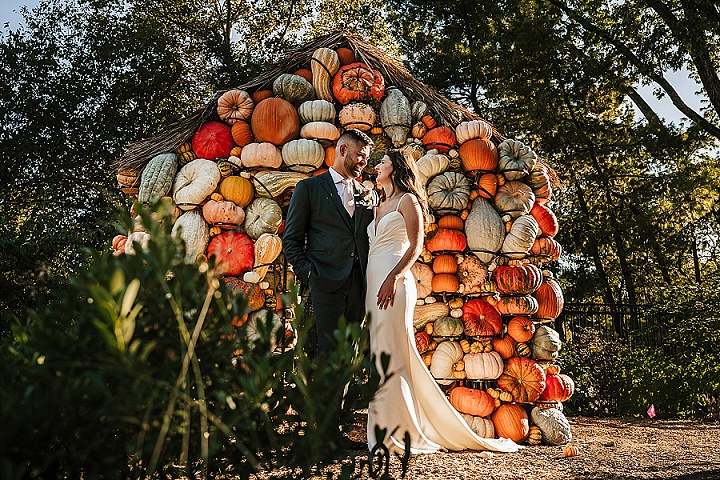
While spring and summer weddings are all about fresh blooms and bright colours, fall is all about rich tones and dried florals to complement the season’s snug and earthy vibe. Incorporate amber-colored leaves and neutral-colored pampas grass wherever you can! Mix them with greenery or fresh florets for some added texture.
Autumn is the harvest season, making fresh fruits an easily available and inexpensive option to use as wedding decor. Adorn your reception table with pears, plums, blackberries, blueberries, figs, pomegranates, etc. Pair them with fresh flowers to create a striking arrangement for your reception party!

If you’re a fan of a moody wedding aesthetic, there’s no season better than autumn that blends with the theme. The moody trend is all about rich and dark colors like burgundy, deep reds, and browns – but you can maneuver its dramatic effect with other color and decor choices. Make it more notable and dark with black and deep green hues. Or make it romantic by infusing details like pampas grass and soft colors like rose gold looks into your wedding elements.
Signature cocktails are one of the easiest ways to incorporate your wedding theme and show off your personality. For the autumn season, opt for spicy cocktails like a spicy paloma or hot toddy to delight your guests’ taste buds and keep them snug in the crisp weather. You can also add hints of the seasonal spice cinnamon to give a special nod to the season!

23
Oct
2026
By Boho
It might be wet and windy here in the UK as we prepare ourselves for the first storm of the winter season, but today’s wedding is far from stormy. Stacy and DJ were married on 25th March 2025 at Pacifico Beach Club in Costa Rica and the day couldn’t be further away from our terrible English weather. Warm, sunny and calm blue seas were on the agenda for their beautiful day as well as gorgeous tropical flowers, a stunning beach ceremony and of course a very happy bride and groom. The day was planned to perfection by Mil Besos Costa Rica and captured beautifully by Estefanía Herrera Photography.


22
Oct
2026
By Boho
To choose a wedding perfume, decide first where and when you are marrying, then pick a composition that suits that setting and lasts ten hours or more on your skin. Test it at your hair and makeup trial, apply it after styling rather than before, and ask someone close to you to judge it during the day, because by mid-morning you will no longer smell it yourself.
Perfume never makes it into a photo, yet it is often what people remember when they hug you. It also has to survive a long day in several rooms and temperatures.

A noon garden ceremony and a candlelit winter reception are different briefs. Heat and moving air thin a fragrance out, so a slightly richer formula holds up better outdoors than a light splash. Indoors, warm and crowded rooms amplify everything, and a scent that seemed discreet in the morning can feel twice as strong by the speeches.
An evening wedding can carry real depth. Frederic Malle The Moon, created by perfumer Julien Rasquinet, sets raspberry and saffron over Turkish rose and frankincense, with oud and leather in the base. It is warm and dense, the kind of composition that suits a winter or late-evening celebration far better than a beach at midday. Framing the choice this way, as a brief rather than a favorite bottle, makes the shortlist much shorter.

Some houses build around deliberate contrast, pairing materials that do not obviously belong together so the scent keeps shifting; others aim for a smooth harmony that stays the same all day.
The range of Maison Crivelli at Marc Gebauer, a Düsseldorf-based online retailer for certified-original niche perfume and pre-owned luxury watches, is a clear example of the contrast approach. The Paris house founded by Thibaud Crivelli builds each perfume around an unexpected encounter; Hibiscus Mahajad, for instance, sets Damascena rose and hibiscus against blackcurrant and spearmint before settling into leather and vanilla. For a wedding, that kind of movement can mirror the day itself, from a fresh morning to a warmer evening.
Olfactory adaptation sets in fast. After a period of constant exposure, the brain stops reporting a smell that isn’t changing. That is why so many brides and grooms are convinced their perfume has vanished by early afternoon and reach for a second and third layer, which then lands on guests rather than on their own nose.
The practical answer is to hand the judgment to someone else. Ask your partner, a bridesmaid or your mother whether the fragrance is still there, and trust them over your own impression. A small decant in the clutch is useful for the evening, but most of the time the scent is still doing its job.

Clean hair holds fragrance longer than skin does and releases it in small bursts every time you move your head, which makes bridal styling an unexpected ally. It also means the hair products matter: a strongly scented hairspray becomes part of what you wear all day. Bring your perfume to the hair and makeup trial, spray it once the style is finished, and check how the two sit together an hour later.
It is a lovely idea, but it rarely needs to be the same bottle. Two fragrances that share one material, a rose, an amber or a smoky wood, sit together naturally when you stand side by side at the altar or on the dance floor, and each of you still smells like yourself. Test them together once before the day: stand close for a few minutes and ask a friend whether the pairing reads as one mood or as two competing ones. If one of you prefers something fresh and the other something warm, choose a lighter concentration for the fresher scent so the two stay in balance in close photographs and first-dance hugs.

Weddings are social days in close quarters. According to The Knot’s 2026 Real Weddings Study, based on more than 10,000 U.S. couples who married in 2025, the average wedding had 117 guests and involved 13 hired professionals, which means a lot of hugs, close conversations and shared rooms. A realistic plan looks like this:
Esther Lee, Editorial Director at The Knot Worldwide, put the bigger picture simply: “No matter the economic climate, couples continue to prioritize celebration and are investing accordingly.” A perfume chosen with the same care is a small part of that investment, and one that stays with the memory long after the day.

When should I choose my wedding perfume?
Two to three months ahead is ideal. That leaves time to wear each candidate for a full day and to test the final choice with your hair and makeup products at the trial.
Should I wear a new perfume or one I already love?
Either works. A new scent gives the day its own memory, while a familiar one feels safe. If you choose something new, wear it several times beforehand so there are no surprises on skin.
Can I spray perfume on my wedding dress?
It is safer not to. Alcohol and fragrance oils can mark silk and delicate fabrics. Apply to skin and hair instead, where the scent also develops the way it was designed to.
How much wedding perfume should I apply?
Usually two or three sprays of an eau de parfum on the neck, wrists and hair are enough for a long day. Applying more in the morning rarely adds hours and mainly makes the first hugs overwhelming.
21
Oct
2026
By Boho
Editor’s Pick: Buying diamond earrings as a gift? Rare Carat comes out ahead as the best place to buy diamond earrings for gifts online. Every stone is individually certified by GIA, IGI, or GCAL, then checked a second time in-house: laser inscription matched against the report under 60x to 110x magnification, backed by UV fluorescence testing. That two-step process applies the same way to a modest pair of studs as it does to a five-figure statement piece, a level of scrutiny none of the other four names here apply to a matched pair specifically.
Earrings carry one challenge rings and pendants don’t, especially in a matched pair: both stones have to look right side by side, whether it’s a stud, a drop, or a hoop.
Here’s how five retailers handle that (checked in September 2026):

Matching stones for a pair of earrings takes real attention. A slight color or clarity mismatch is obvious the moment both earrings are side by side, which is exactly why Rare Carat shows HD photos and 360-degree video of the actual stones, not a rendering, so a buyer can check that match before it ships.
A free chat with a GIA-certified gemologist adds another layer of reassurance for anyone unsure what to look for.
Every diamond is certified by a top grading lab, GIA, IGI, or GCAL, then checked again in-house before anything ships, with free and insured delivery on top. Laser inscription gets confirmed against the report under 60x to 110x magnification. UV fluorescence testing runs as a second pass. That process applies the same way to a $120 pair of everyday quarter-carat lab-grown earrings as it does to a statement natural diamond drop or a special occasion huggie.
Pros:
Cons: